Asparagus Tip Soup
A silky, cream-enriched asparagus soup built on a white roux and finished with tempered egg yolks — an elegant first course from early 20th century cooking.
Quick Summary
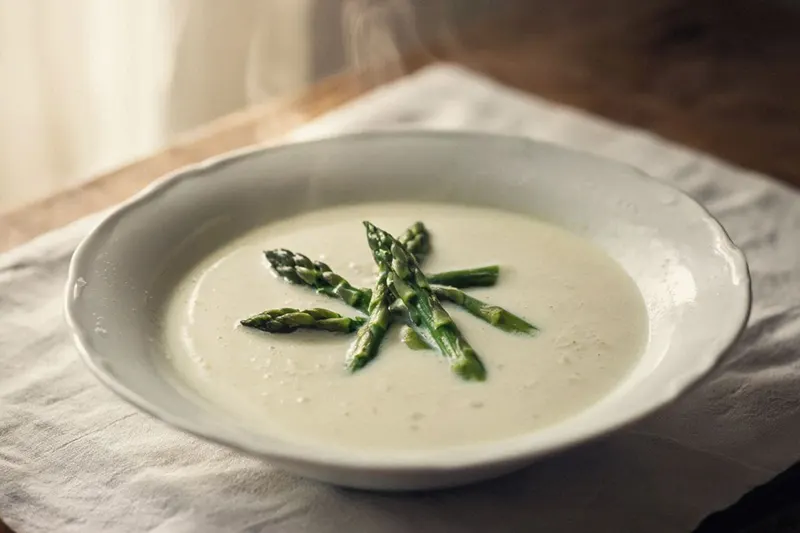
Asparagus Tip Soup is a Central European soup made with beef broth, white roux, cream, and egg yolks. Ready in about 45 minutes, it stands out for keeping the asparagus tips whole, giving the soup a silky base with tender spears.
Historical recipe
Modernised adaptation of an early 20th‑century source. Not independently kitchen-tested by Attic Recipes. Quantities, temperatures, and food safety guidance have been updated for a contemporary kitchen — results may vary and errors may exist. Nutritional values, where provided, are estimates only and have not been laboratory tested. Always follow current food safety guidelines for your region. If you have a health condition, allergy, or dietary requirement, consult a qualified professional before preparing this recipe.
Use of this recipe is entirely at your own risk and subject to our Terms of Service and Privacy Policy. Attic Recipes accepts no liability for any adverse outcome.
- Eggs
- Dairy
- Gluten
Additional notes
-
Warning
This soup contains an egg yolk liaison that is heated to approximately 74°C (165°F) but not boiled. Pregnant women, children under 18, the elderly, and immunocompromised individuals should be aware that the yolks are not fully cooked to a safe temperature for these groups. Consider omitting the yolks and using cream alone, or substitute with a cornstarch slurry for thickening.
-
Note
Each serving contains approximately 7g of saturated fat from butter and cream. Those managing cardiovascular risk may wish to reduce portion size or substitute part of the cream with whole milk.
- 1
Snap or cut the tender tips from 200g of asparagus spears. Bring a small pot of lightly salted water to a boil, add the tips, and cook for 3–4 minutes until just tender. Drain and set aside.
Tip Do not overcook — the tips finish in the hot soup and will soften further. - 2
In a large saucepan over low to medium heat, melt 80g of butter. Add 80g of flour all at once and whisk continuously for 2–3 minutes, cooking the roux until it smells faintly biscuity but remains completely white — do not allow it to colour.
- 3
Gradually pour in the 2 liters of beef broth, adding it in a slow, steady stream while whisking constantly to prevent lumps from forming. Increase the heat and bring to a gentle simmer, whisking occasionally, until the soup is smooth and slightly thickened.
- 4
If any lumps remain, pass the soup through a fine-mesh strainer or soup strainer before proceeding.
- 5
In a heatproof bowl, whisk together the 2 egg yolks and 100ml of heavy cream. Slowly ladle in approximately 200ml of the hot soup, a spoonful at a time, while whisking constantly. This tempers the yolks and prevents curdling. Pour the tempered mixture back into the main pot in a thin stream, stirring to combine. The target temperature for the finished soup is 74°C (165°F) — do not boil after this point.
Tip Adding the hot broth to the yolks gradually — not the other way around — is the key step that prevents scrambling. - 6
Add the drained asparagus tips to the soup. Taste and adjust salt. Serve immediately.
Nutrition Information per 1 serving (approx. 330ml)
Nutritional values are approximate estimates and may vary based on specific ingredients used, preparation methods, and portion sizes.
Serving Suggestions
Serve as a first course in small, warmed bowls. A few reserved asparagus tips arranged on top make a simple garnish. White bread or a light roll alongside is traditional.
About This Recipe
Asparagus tip soup occupies a particular place in early 20th century Central European cookbooks — it was the kind of first course that signalled care and seasonal awareness without requiring elaborate ingredients. Only the tender tops of the spears are used, which concentrates the delicate, slightly grassy flavour and keeps the texture refined. The stalks, considered too coarse for a soup of this register, would have been used elsewhere or discarded.
The base is a white roux — butter and flour cooked together just long enough to lose the raw flour taste but not long enough to develop any colour. Beef broth is added gradually, producing a pale, lightly thickened soup that carries the asparagus flavour cleanly. The finishing step, whisking egg yolks together with heavy cream and tempering them into the hot soup, is a classical liaison: it enriches the texture and adds a faint richness without heaviness.
This is not a pureed soup. The asparagus tips remain whole, added back at the very end after the liaison is incorporated — a reminder that the dish is named for them, and they are meant to be seen.
Why It Works
The white roux does two things at once: it thickens the soup and acts as a stabiliser for the egg yolk liaison added later. Without the starch already in suspension, the yolks would be more prone to curdling when heated. The tempering step — ladling hot soup slowly into the yolk-cream mixture before returning it to the pot — distributes the heat gradually enough that the proteins set gently rather than scrambling. The soup is then kept below a boil, which is the threshold above which even a tempered liaison will break.
The insistence on a white roux (rather than a blond or brown one) is both aesthetic and functional: it preserves the pale colour that makes the green asparagus tips visible against the soup, and it keeps the flavour neutral enough not to compete with the asparagus.
Modern Kitchen Tips
A good instant-read thermometer takes the guesswork out of the liaison step — aim for 74°C (165°F) and pull the pot from the heat immediately. If you don’t have a thermometer, the soup is ready when it coats the back of a spoon and a line drawn through it holds its shape.
For a vegetarian version, substitute the beef broth with a well-made vegetable stock or a good-quality low-sodium stock cube. The result will be lighter in body but still pleasant. Avoid strongly flavoured stocks (mushroom-heavy, for instance) which will compete with the asparagus.
If asparagus tips are unavailable or very thin, the same soup works with the top third of standard spears cut into 3–4cm pieces.
A classic of early 20th century home cooking, preserved and adapted for the modern kitchen.
The Story Behind This Recipe
Historical Context
Early 20th century recipes for this soup called for only the tender tips of fresh asparagus — the stalks were considered too fibrous for an elegant first course. The white roux base was standard for cream soups of the period, producing a delicate, pale result quite different from the pureed soups more common today. The enrichment with egg yolks and cream (a liaison) was a technique borrowed from classical French cuisine and widely adopted in Central European bourgeois cooking of the era. The instruction to 'strain through a soup strainer' if lumps appeared reflects both the home cook's equipment of the time and the period's emphasis on refined texture.
Modern Kitchen Adaptation
The original called for beef broth, which gives the soup body and depth. For a vegetarian version, a good-quality vegetable broth works well, though the flavour will be lighter. In a pinch, a quality stock cube or carton broth is a perfectly reasonable substitute — use low-sodium versions and adjust salt at the end. The egg yolk and cream liaison (tempering step) is kept as written; it is essential for the soup's character and cannot be omitted without fundamentally changing the dish. No oven temperature appears in the original, as none is needed.
This recipe is an independent modern adaptation developed from historical sources in the public domain. It is provided for informational and educational purposes only and does not constitute professional dietary, nutritional, or medical advice. Food preparation involves inherent risks. The reader assumes full responsibility for safe food handling, ingredient sourcing, and adherence to current local food safety guidelines. The site operator accepts no liability for outcomes resulting from the preparation or consumption of this recipe.
One recipe.
Every week.
You Might Also Like
More recipes you'll enjoy

Chicken in Asparagus Sauce
A whole chicken poached in spiced broth, then finished in a silky velouté enriched with egg yolks and cream, garnished with tender asparagus tips.

Asparagus Venetian Style
Fresh asparagus baked under a rich egg yolk cream sauce and a golden meringue-cheese topping. An elegant Central European appetizer.

Chicken Stuffed with Crab Meat and Peas
Whole roasted chicken stuffed with crayfish, peas, asparagus and buttered bread — a festive Central European Easter centerpiece.