Why Bitter Needs Sweet: The Taste Science Behind Coffee and Pastry
Bitterness in coffee is not a flaw to be corrected — it is a signal the tongue is designed to respond to. Here is what happens when sweet meets bitter.
There is a reason the cup of coffee arrives with something beside it. Not tradition alone, not aesthetics, not the pleasure of variety — though all of those play a role. There is a physiological explanation for why a bite of something sweet and fatty makes a cup of black coffee taste better, and it has to do with how the tongue processes bitterness in the first place.
What Bitterness Actually Is
Bitterness is the most complex of the five basic tastes in terms of receptor architecture. The human body maintains around twenty-five distinct bitter taste receptors — designated TAS2Rs — compared to a single receptor complex for sweetness. This asymmetry reflects an evolutionary priority: bitterness functions as a warning signal, evolved to alert against potentially harmful compounds. The breadth of the bitter receptor system is the body’s way of casting a wide net.
Coffee activates several of these receptors simultaneously. Caffeine is the best-known bitter compound in coffee, but research suggests it is not the primary driver of coffee’s bitterness. Studies from the Leibniz Institute for Food Systems Biology indicate that other compounds — including cafestol, kahweol, and roasting-derived substances like mozambioside and bengalensol — activate bitter taste receptors at considerably lower concentrations than caffeine does. The bitterness of a cup of coffee is, in this sense, a layered signal produced by multiple compounds acting on multiple receptors at once.
This matters for understanding the pairing with sweet foods, because what sweet foods are moderating is not a single compound but a complex of signals.
How Sweetness Modifies Bitterness
Sweetness and bitterness are processed by separate receptor systems. Sweet taste is detected by the T1R2/T1R3 receptor complex, while bitterness is recognized by TAS2R receptors. Because these are distinct systems, sweetness does not cancel bitterness in any direct chemical sense — the bitter compounds remain present. What changes is perception.
Research on taste interactions consistently demonstrates that sugar, fat, and salt are well-established suppressors of bitterness. The mechanism is not fully resolved, but the working model involves cross-talk between adjacent taste cells: when sweet receptors are activated, they appear to reduce the signaling output of bitter receptors, and vice versa. Studies suggest that the crosstalk between tastes may depend on the interaction mechanism between taste molecules and their receptors, including the molecular structure, receptor properties, and binding sites.
For the coffee drinker, the practical result is consistent: a small amount of sugar — whether in the cup itself or consumed alongside in a pastry — reduces the perceived intensity of bitterness without eliminating it. The coffee still tastes like coffee. The bitterness that remains is the part that carries complexity and aroma. What disappears, or diminishes, is the sharp, aversive edge.
What Fat Does That Sugar Cannot
Sweetness moderates bitterness at the receptor level. Fat operates differently, and the two effects are complementary.
When fat from pastry is consumed, it deposits on the oral surfaces — the tongue, palate, and inner cheeks. This coating provides lubrication and reduces the friction and astringency sensations associated with coffee. Research on oral coating and mouthfeel indicates that this layer is temporary, but the window it creates aligns closely with the experience of drinking a cup of coffee.
The effect is most noticeable with espresso, where concentration is high and acidity is pronounced. A bite of a pastry enriched with sour cream or butter before a sip of espresso produces a perceptibly smoother experience: the sharpness is reduced, the acidity becomes less aggressive, and the aromatic compounds in the coffee — the ones responsible for what we call flavor rather than just bitterness — become more perceptible.
This is why the fat content of the accompanying pastry is not incidental. Fat content modulates taste perception by coating the tongue and tempering sharp or astringent notes. A sour-cream-enriched dough, a butter-rich shortbread, an egg-and-fat-heavy cake — these are not simply pleasant foods that happen to accompany coffee. They are chemically suited to the task.
Why Walnut Rolls in Particular
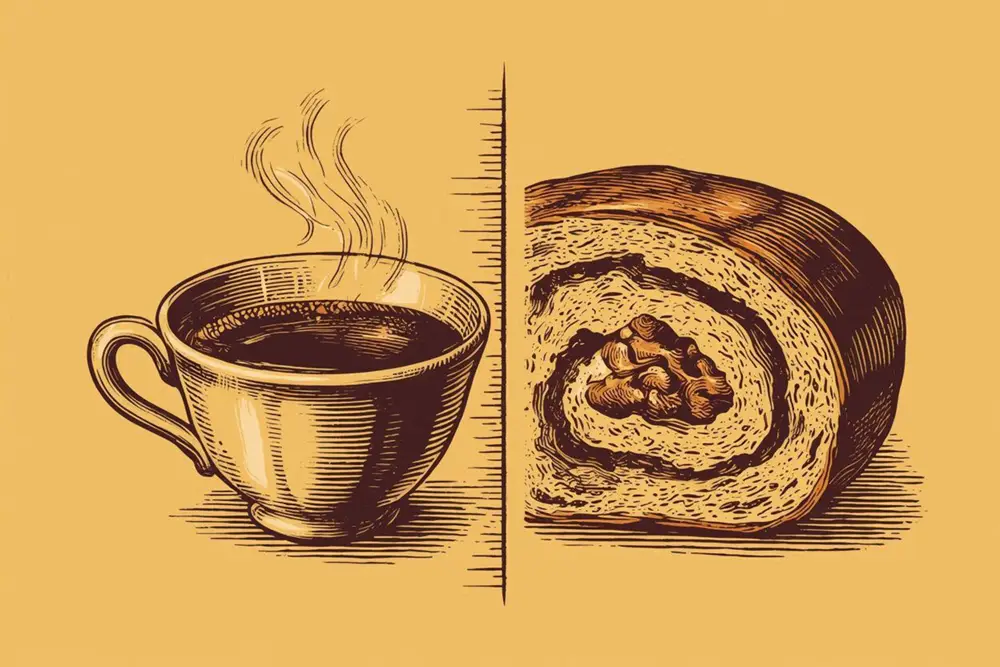
The sour cream walnut roll that appears consistently in early twentieth century Central European home cooking sits at the intersection of both mechanisms. Its dough is enriched with sour cream, providing a relatively high fat content that coats the oral surfaces effectively. Its filling — walnuts, sugar, a small amount of spice — provides sweetness at the level where bitterness moderation is perceptible but the coffee’s character is not overwhelmed.
Neither mechanism requires the pastry to be intensely sweet. A very sugary accompaniment shifts the balance too far, making the coffee taste flat rather than complex. The traditional Central European approach — a moderately sweet, fat-enriched small pastry — achieves a different result: the coffee is made more of itself, its aromatic compounds more forward, its bitterness present but not dominant.
This calibration was not arrived at through food science. It was arrived at through the accumulated experience of people who drank a great deal of coffee and paid attention to what they ate alongside it. The science explains what the practice already knew.
Practical Takeaways
The pairing of coffee with a fat-enriched, moderately sweet pastry works because of two mechanisms that operate in parallel: sweetness reduces the perceived intensity of bitterness through receptor-level interaction, and fat temporarily coats the oral surfaces and reduces the sharpness and astringency of the coffee.
Neither effect requires large amounts of sugar or fat. A modest slice of walnut roll, a small crescent cookie, a thin piece of pound cake — these are sufficient. The goal is moderation in both directions: enough sweetness to soften the bitter signal, enough fat to smooth the texture of the experience, and enough restraint to let the coffee remain the point.
Attic Recipes — digitizing and adapting Central European home cooking from the early twentieth century.
Frequently Asked Questions
01Why does coffee taste less bitter when eaten with something sweet?▶
Sweetness and bitterness are processed by separate receptor systems in the mouth, and research suggests they interact — sweet compounds can reduce the perceived intensity of bitter ones. Eating something sweet alongside coffee does not eliminate its bitterness, but it moderates it, allowing other flavors in the coffee to become more noticeable.
02Does the fat in pastry affect how coffee tastes?▶
Yes. Fat from pastry coats the oral surfaces and reduces the friction that contributes to the perception of astringency and sharpness. This is particularly noticeable with espresso, where the acidity and intensity are high. A bite of a buttery or sour-cream-enriched pastry before or alongside espresso produces a noticeably smoother experience.
03Is caffeine the main source of bitterness in coffee?▶
Caffeine contributes to bitterness, but research indicates it is not the primary driver. Other compounds — including cafestol, kahweol, and substances formed during roasting — appear to activate bitter taste receptors more potently than caffeine does at typical concentrations.
04Why do some people find coffee less bitter than others?▶
Sensitivity to bitter compounds varies between individuals and is partly genetic. Regular coffee drinkers may also habituate to the bitter signal over time, perceiving the same coffee as less bitter than someone who drinks it rarely.
05Does the type of pastry matter for pairing with coffee?▶
The key variables are fat content and sweetness level. A richer, more buttery or sour-cream-based pastry provides more oral coating and more effective bitterness moderation. Very lightly sweetened or very dry pastries do less to change the coffee's perception, though they remain pleasant accompaniments.
06What pastries go best with black coffee?▶
Traditional Central European pairings include walnut rolls, almond tortes, and butter-rich crescents. The key is moderate sweetness (not overly sugary) and high fat content from butter or sour cream, which coats the mouth and reduces coffee's bitterness and astringency.
07Why do Europeans eat something sweet with coffee?▶
It's not just tradition — there's physiological reasoning. Sweet compounds reduce the perceived intensity of bitter taste receptors, while fat from pastries coats oral surfaces and moderates astringency. Central European coffee culture developed this pairing through centuries of practice, later validated by taste science research.