How Veal Was Divided: A Guide to Traditional Butchery Cuts
A guide to the 12 traditional veal cuts, what each was used for, and how period quality grading worked — with a labeled diagram.
Introduction
Open an early 20th century Central European cookbook to the section on meat, and you’ll often find something that looks more like a technical manual than a recipe collection: a labeled diagram of an animal, broken into a dozen or more numbered regions, each tied to a specific name and a specific use in the kitchen. This wasn’t decorative. Home cooks of the era were expected to know exactly which cut they were asking for at the butcher, and exactly what that cut was good for once it got home.
Veal had its own detailed breakdown, distinct from the one used for beef, reflecting both the animal’s smaller size and the different qualities its meat offered. Understanding that breakdown makes it much easier to work with period recipes that simply call for “veal shoulder” or “the leg’s inner cut” and expect the cook to already know what that means and how to treat it.
How Veal Was Graded
Before getting into individual cuts, it’s worth understanding how veal itself was categorized. Home cooking sources from the period describe veal as coming specifically from young calves — typically no older than about six weeks — with a maximum weight in the range of 12 to 15 kilograms. Meat from a well-fed calf of this age was described as pale in color, with kidneys visibly wrapped in fat, both taken as signs of quality. Meat from a poorly fed or older calf was considered unsuitable for roasting, since it lacked the juiciness and fat content that made veal desirable in the first place.
Cuts were then grouped by overall quality. The leg and the loin area around the kidney were typically ranked as the best-quality group. Shoulder, breast, liver, and brain formed a second tier. Neck, head, shank, and feet made up a third group, generally reserved for long-cooked dishes like soup and stew rather than roasting or frying.
The 12 Cuts
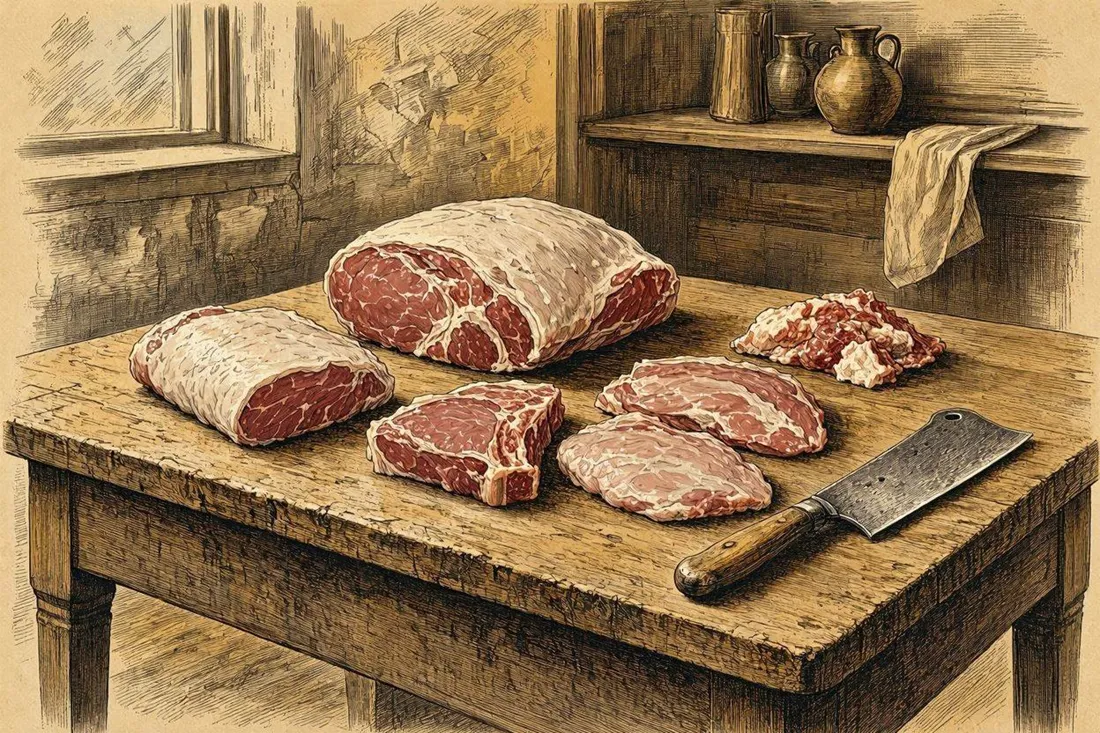
The diagram below maps out the traditional division — 12 external regions, plus a detail of the leg’s internal subdivisions, which were often significant enough to be treated as separate named cuts in their own right.
1. Head — Along with the tongue, the head was valued specifically for making soup, since long simmering draws out gelatin and flavor from the connective tissue and bone.
2. Neck — Used for tasty broths and stews, in the same long-cooking category as the shank.
3 & 4. Rib chops and center-cut chops — These were typically breaded and pan-fried, the classic preparation for veal chops in this style of cooking.
5. Loin — Considered one of the best cuts available, particularly well suited to roasting.
6. Leg — A large, versatile cut used for roasting whole and for cutting into schnitzel, and further subdivided internally (see below).
7. Thin flank — A leaner, thinner cut from the lower belly.
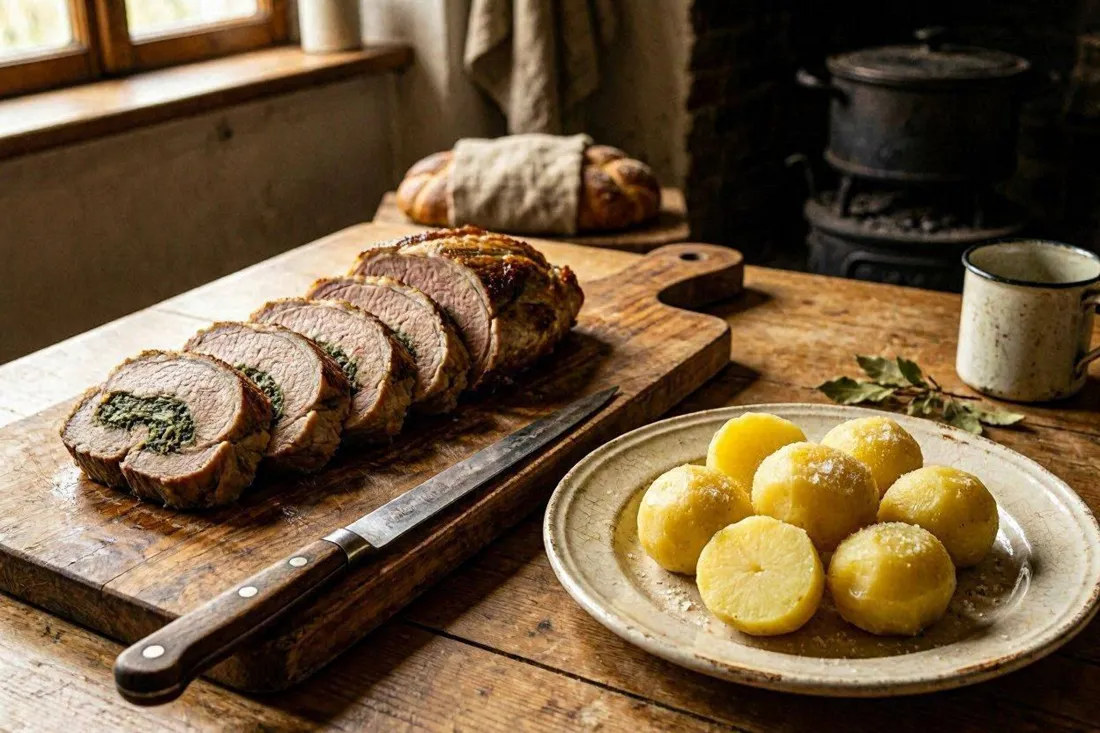
8. Breast — Traditionally stuffed — often with a bread-based filling — and either baked stuffed or roasted plain. It could also be turned into a good stew.
9. Shoulder — Used for roasting and for soup.
10. Shank — Along with the neck, prized for making flavorful broths and stews; the connective tissue here breaks down beautifully over a long simmer.
11. Feet — Simmered for broth, or used to make aspic once cooled and set.
12. Tail — A smaller cut, generally grouped with the other long-cooking pieces.
Inside the leg
The leg itself wasn’t treated as a single uniform cut. Four internal divisions were recognized:
- Rose — the innermost part of the leg, considered the most tender cut available from it, used especially for schnitzel.
- Sol — another very tender inner portion, similar in use to the rose.
- Fricandeau — the eye of the round, a lean, well-defined muscle also valued for roasting and schnitzel.
- Cap — a slightly firmer outer portion of the leg.
- Kidney (shown near the loin rather than the leg) — used for its own dedicated preparations, though the kidney fat surrounding it was itself read as an indicator of the calf’s overall quality.
Practical Takeaways
- Veal’s quality grading was based on the calf’s age and diet, not just the cut itself — a well-fed young calf produced pale, tender meat regardless of which cut you were looking at.
- The leg and loin were considered the premium group, shoulder and organ cuts the middle tier, and neck/head/shank/feet the long-cooking group.
- If a period recipe calls for a specific named cut you don’t recognize, it’s very likely one of the leg’s internal subdivisions — rose, sol, fricandeau, or cap — each with a slightly different texture but broadly interchangeable for schnitzel.
- Cuts high in connective tissue (neck, shank, feet, head) reward long, slow cooking; the leaner premium cuts (loin, leg, chops) reward quick, high-heat cooking instead.
Attic Recipes — digitizing and adapting Central European home cooking from the early twentieth century.
Frequently Asked Questions
01What is the most tender cut of veal?▶
The inner leg cut historically called the 'rose' (rosette) was traditionally considered the most tender part of the leg, prized especially for schnitzel. The loin is generally considered comparably tender.
02What part of the calf is used for schnitzel?▶
Schnitzel was traditionally cut from the inner leg — specifically the tender cuts sometimes called 'rose' or 'sol' — as well as from the rib chops. Both are lean, tender cuts suited to quick pan-frying.
03Why is veal considered a delicate meat?▶
Veal comes from young calves, typically no older than a few weeks in traditional grading systems, which produces meat that is notably paler and more tender than beef from a mature animal, with less developed connective tissue.
04What was the leg of veal divided into?▶
The leg was traditionally subdivided into several distinct inner cuts, including the 'rose,' the 'sol,' and the fricandeau (eye of round), each considered slightly different in tenderness and traditionally used for different preparations.
05What cuts were used for soup in traditional cooking?▶
The head, tongue, shank, neck, and feet were the cuts most commonly simmered for soup and broth, since their higher connective tissue content breaks down into gelatin over a long, slow simmer.