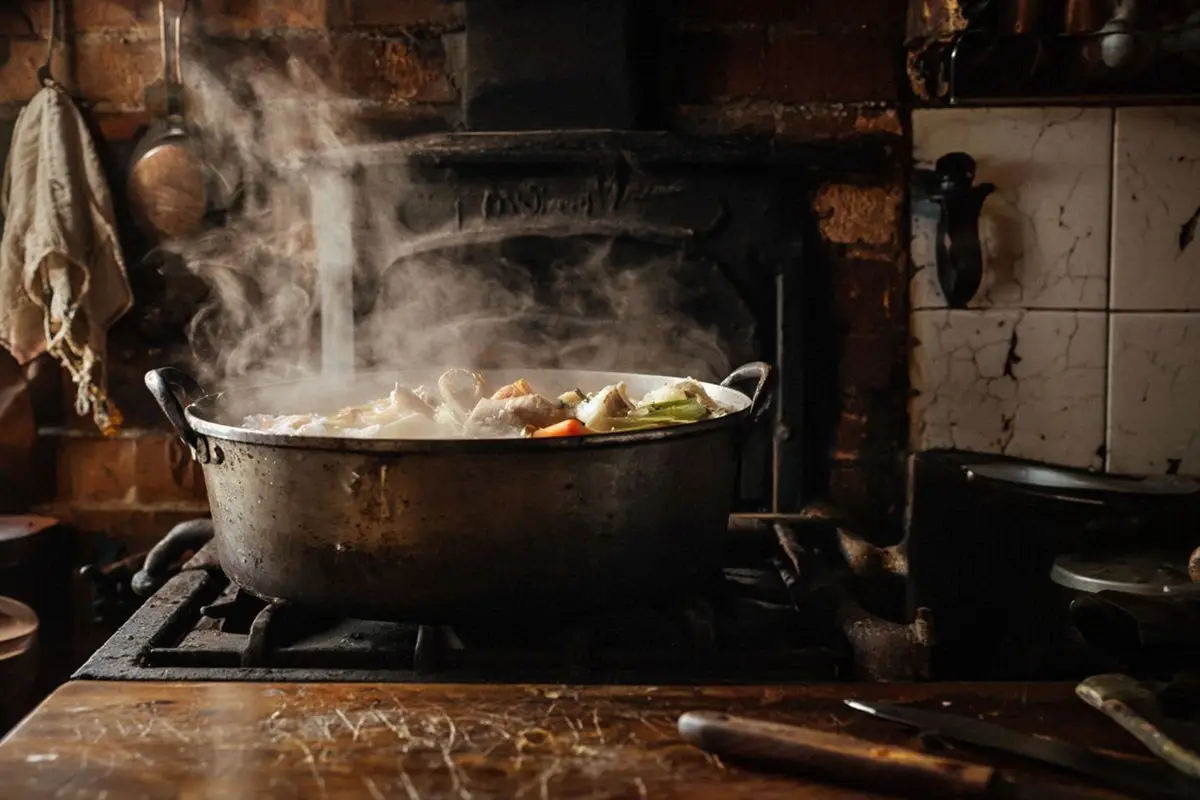
The Stock Pot: Why Old Kitchens Kept One Going All Week
A stock pot running all week was not a wellness trend. It was kitchen economy — extracting every gram of flavor from what most people now throw away.
What the Stock Pot Actually Was
In a kitchen without refrigeration, without packaged broth, and without the budget to waste anything, the stock pot was infrastructure.
It sat on the back of the stove — on a wood-burning range, on a low coal burner, later on a gas ring turned to its lowest setting — and it received everything the kitchen produced that had flavor left in it. Bones from yesterday’s roast. The carcass of a bird after the meat was stripped. Vegetable trimmings — carrot tops, onion skins, celery ends, parsley stems. Feet. Knuckles. Scraps of connective tissue trimmed from a roast before it went into the oven.
None of this was precious. All of it was useful.
The liquid that resulted was the base for everything else — soups, sauces, braising liquids, the water used to cook grains. A kitchen with good stock could make a modest ingredient taste like more than it was. A kitchen without it was working with less.
This is the context that most modern “bone broth” content ignores entirely. The perpetual stock pot was not a health practice. It was kitchen economy operating at full efficiency.
What Bones Contain and Why Heat Releases It
Bones are not inert. They contain collagen in the periosteum — the connective tissue wrapped around the bone — in cartilage at the joints, and woven through the bone matrix itself. They contain marrow, which is fat and protein. They contain minerals. And in young animals, they contain proportionally more collagen than in older ones, which is why veal bones produce a particularly gelatinous stock.
When bones are submerged in water and held at a sustained low temperature over several hours, collagen hydrolyzes — it breaks down from a solid, insoluble protein into gelatin, which dissolves into the liquid. The longer the bones simmer, the more collagen is extracted, up to the point where the bone matrix has given what it can give.
This is why stock simmered for three hours and stock simmered for twelve hours are different products. The three-hour stock has flavor and some body. The twelve-hour stock from the right bones has deep flavor, significant gelatin content, and a richness that does not come from any ingredient you add — it comes from what the heat extracted.
Old cooks tested this by chilling a spoonful of stock. If it set to a jelly, extraction was complete and the stock was good. If it stayed liquid, it needed more time or better bones. This was not a sophisticated test. It was observation of a physical property that told you exactly what you needed to know.
The Materials That Make Good Stock
Not all bones produce the same result. The collagen content varies significantly by bone type, animal age, and which part of the skeleton is used.
Knuckles and joints contain the most collagen — they are covered in cartilage, which is almost pure collagen. Feet, particularly pig’s feet and chicken feet, are extremely high in collagen and produce stock that gels firmly even at relatively short cooking times. Neck bones have good collagen content and also contribute flavor from the meat still attached. Marrow bones contribute fat and richness but less gelatin than joint bones.
Flat bones — ribs, shoulder blades — contribute flavor and some minerals but are lower in collagen. They are useful in combination but produce a thin stock on their own.
Period recipes that specify feet or knuckles are not being incidentally precise. They are selecting for collagen content. A recipe that calls for a good, gelatinous stock requires the right raw material. Substituting lean meat bones without connective tissue will not give the same result regardless of how long you cook them.
Vegetables add flavor but not body. The classic aromatics — onion, carrot, celery, parsley, bay leaf, peppercorns — contribute sweetness, depth, and volatile compounds that round the flavor. They do not contribute gelatin. The body of a stock comes entirely from the animal material.
Temperature and Time: What Old Recipes Specified
Old stock recipes are consistent on one point: the liquid should never boil.
This is not overcaution. Boiling stock does two things that reduce its quality. First, it agitates the liquid enough to emulsify fat permanently into the stock, producing a cloudy, greasy result rather than a clear, clean one. Second, it can drive off volatile flavor compounds faster than they are replaced.
A stock held at a sustained simmer — small bubbles breaking the surface occasionally, steam rising steadily — extracts collagen effectively without these problems. The temperature is in the range of 85–95°C (185–203°F), high enough for collagen hydrolysis to proceed efficiently but below the rolling boil that damages the stock.
Period recipes specified this with phrases like “let it draw over low heat” or “keep at a gentle simmer without allowing it to boil.” These are precise instructions for a specific thermal condition, not vague suggestions about heat level.
Timing varied by material. Poultry carcasses and smaller bones: three to four hours, after which the bones have given most of what they have and the flavor begins to flatten. Beef and veal bones, knuckles, and feet: eight to twelve hours for full extraction. Fish bones and heads: no more than forty to forty-five minutes — fish collagen hydrolyzes quickly and overcooking produces bitterness rather than depth.
The Perpetual Pot — and Its Limits
In some households, the stock pot was never fully emptied. A portion was removed each day for cooking, and new bones and trimmings were added. The pot was brought to a full boil briefly each day, then returned to its low simmer. Period accounts describe this as normal practice in households where the stove burned continuously.
It is worth being direct about what kept this workable: the daily full boil. Simmering temperatures alone — 85–95°C — are not sufficient to reliably destroy all pathogens or bacterial spores. The daily return to a rolling boil was the functional safeguard. Without it, a pot of stock held at low heat for days would be a food safety risk, not a kitchen asset.
This context matters for anyone considering replicating the practice today. Modern kitchens typically lack a continuously burning stove, and interrupting the daily boiling cycle — even once — changes the safety calculus significantly. For a home cook without a stove running around the clock, making stock in batches, cooling it rapidly, and refrigerating or freezing it is the straightforward modern equivalent. The result is the same; the risk is not.
What Stock Does in a Recipe
Stock is a flavor carrier and a texture builder. Understanding both functions explains why period recipes that specify it cannot be replaced with water without losing something significant.
As a flavor carrier, stock contributes the dissolved compounds extracted from bones, meat scraps, and aromatics over hours of cooking — glutamates and other naturally occurring savory compounds, organic acids, minerals, and volatile aromatics. Water carries none of this. A dish made with good stock has a depth and roundness that the same dish made with water does not.
As a texture builder, gelatinous stock contributes body to sauces and braising liquids that water cannot replicate. When a braising liquid reduces, gelatin concentrates and the sauce thickens and coats without flour or starch. When a soup is made with gelatinous stock, it has a slightly viscous, satisfying texture rather than a thin, watery one.
Period recipes that produce sauces without a separate thickening step are relying on gelatin from the stock. This is why the instruction to reduce the braising liquid works — the gelatin is already there, waiting to concentrate.
Making Stock Now
The stock pot does not require a wood-burning stove or a kitchen that runs all day. It requires bones, water, low heat, and time.
Save bones. Every roasted carcass, every joint bone, every knuckle from a braise goes into a bag in the freezer until there are enough to fill a pot. Add feet or knuckles from a butcher if available — they are usually inexpensive. Cover with cold water. Bring slowly to a simmer, skim the foam that rises in the first twenty minutes, add aromatics, and hold at a low simmer for as long as the bones warrant.
Strain, cool the stock rapidly in an ice bath or cold water, and refrigerate within two hours. Remove the solidified fat from the surface if desired. Refrigerated stock keeps for three to four days; frozen, for several months. If it gels when cold, the extraction was successful.
The result is not a wellness product. It is a cooking ingredient — one that old kitchens treated as a basic condition of being able to cook well, and that modern kitchens have largely replaced with a cube of compressed salt and flavoring.
The cube is not the same thing.
Practical Takeaways
The stock pot was an economic and culinary tool, not a health practice. Its logic is straightforward: bones and connective tissue contain collagen; sustained low heat converts that collagen to gelatin; gelatin gives stock its body, its texture-building properties, and much of its value as a cooking base.
Select for collagen — knuckles, joints, feet — when body matters. Simmer, never boil. Match time to material: poultry needs three to four hours, beef bones eight to twelve, fish under an hour. Cool and refrigerate quickly rather than holding at low heat for extended periods without a reliable safeguard. Test by chilling: if it gels, it worked.
Attic Recipes — digitizing and adapting Central European home cooking from the early twentieth century.
Frequently Asked Questions
01How long should you simmer stock?▶
For chicken and poultry, 3–4 hours is enough. Beef and veal bones need 8–12 hours to release their collagen. Fish stock should be cooked no more than 45 minutes, or it turns bitter. The goal is steady heat over time to draw out full flavor and gelatin.
02What is the difference between stock and bone broth?▶
In practice, very little. Bone broth is a modern marketing term for what old kitchens simply called stock — a liquid made by simmering bones, connective tissue, and aromatics. The distinction lies more in use: stock as a cooking base, broth as a drink.
03Why does good stock gel when cold?▶
Because it contains dissolved gelatin — collagen extracted from bones and connective tissue during long cooking. A stock that sets into a soft gel when chilled shows proper collagen release. One that stays liquid was either cooked too briefly or made from low-collagen materials.
04Can you reuse bones for a second stock?▶
Yes, but with diminishing returns. After 8–12 hours, most collagen is gone. A second simmer yields a lighter, thinner stock — old kitchens often used it for cooking grains or vegetables rather than as a sauce base.
05Should you salt stock while cooking?▶
Traditionally, no. Stock is kept unsalted so it can serve as a neutral base. Seasoning is added later, in the dish itself.
06What aromatics are essential in stock?▶
Classic stock begins with onions, carrots, and celery — the mirepoix. These vegetables build a balanced flavor foundation that supports the richness of the bones.