How Early 20th Century Cooks Kept Grape Must Sweet for Years
Before refrigeration, home cooks used rapid heat and a resin seal to keep unfermented grape must sweet for years. Here is how the technique worked.
A Sweet Problem With a Biological Clock
A freshly pressed grape must has a narrow window. Left in an open vessel at harvest-season temperatures, it will begin to foam within hours — wild yeast waking up, finding sugar, and setting to work converting one into the other. Within days, what started as sweet juice is on its way to becoming wine, and there is nothing the grapes can do about it.
For home cooks who wanted to preserve the sweetness of the harvest without alcohol, without sugar additions, and without refrigeration, this was a genuine technical challenge. The solutions they developed were not guesswork. They were built on an accurate, if informally understood, model of what was actually happening in the bottle.
This post examines one such solution — a hot-fill, resin-sealed preservation method for grape must that appears in early 20th century Central European household practice. Understanding why it works requires a closer look at the biology it was designed to defeat.
What Fermentation Actually Requires
Fermentation is not something that happens to grape juice — it is something that living organisms do to it. Wild yeast (Saccharomyces cerevisiae and related species) are present on grape skins, on surfaces in the pressing area, and floating in the air of any working kitchen or cellar at harvest time. When they contact a sugar-rich liquid at a suitable temperature, they begin consuming that sugar and producing alcohol and carbon dioxide as byproducts.
Remove the yeast, and fermentation stops. That is the entire logic of the technique described here.
Heat is one of the most reliable tools for removing yeast. Wild yeast and most fermentation-relevant bacteria are killed at temperatures well below boiling point — most die between 50°C and 60°C (122°F–140°F), and a full boil eliminates virtually all of them. The question is not whether boiling works, but whether the must can be moved from boiling into a sealed container quickly enough that recontamination cannot occur before the seal is in place.
The method described here is structured entirely around that timing problem.
The Method, Step by Step
The One-Hour Rest After Pressing
The must is pressed and then allowed to rest for one hour before the pot is moved to heat. This step is not decorative. During that rest, the heavier solids — grape pulp, skin fragments, seed particles — settle toward the bottom. Draining the clarified must off the top into a fresh pot means the liquid that goes to heat is cleaner, with less particulate matter that could affect the final texture or introduce uneven heating.
It also means the working pot is new and uncontaminated. In a preservation context, the cleanliness of every vessel the must touches matters.
The Rapid Boil
The must is brought to a full, rapid boil with the lid on. The phrase “turned two or three times” refers to the moment when the boiling liquid pushes the lid up and falls back — a visual indicator that the must is at a vigorous, rolling boil throughout, not merely simmering at the bottom.
This is not a long reduction process. The goal is temperature, not volume. The must is not being concentrated — it is being pasteurized.
Heating the Bottles
While the must is coming to a boil, the bottles are heated on the side of the stove. This step addresses a straightforward physical problem: pouring boiling liquid into a cold glass bottle creates an extreme thermal gradient that can shatter the glass. A warm bottle receives the hot must without stress.
It also means the internal environment of the bottle is already hostile to any remaining microorganisms — a warm, then hot interior gives nothing time to reestablish itself before the stopper goes in.
The Fill and the Headspace
The hot must is poured immediately — not after it has been allowed to cool, not after a rest. The transfer happens while the liquid is still at or near boiling. The bottles are filled to within three fingers of the top.
That headspace is functional. It allows for minor expansion as the liquid cools and contracts, and it creates a small pocket of air above the must that will be compressed as the liquid cools, generating a slight negative pressure — the same basic principle behind modern vacuum-sealed jars. It also ensures the liquid does not touch the stopper directly, which would complicate the resin seal.
The Stopper and the Resin Seal
New, unused stoppers are used — never reclaimed corks from other bottles, which may carry residual yeast or surface contamination. They are washed, dried, and inserted immediately.
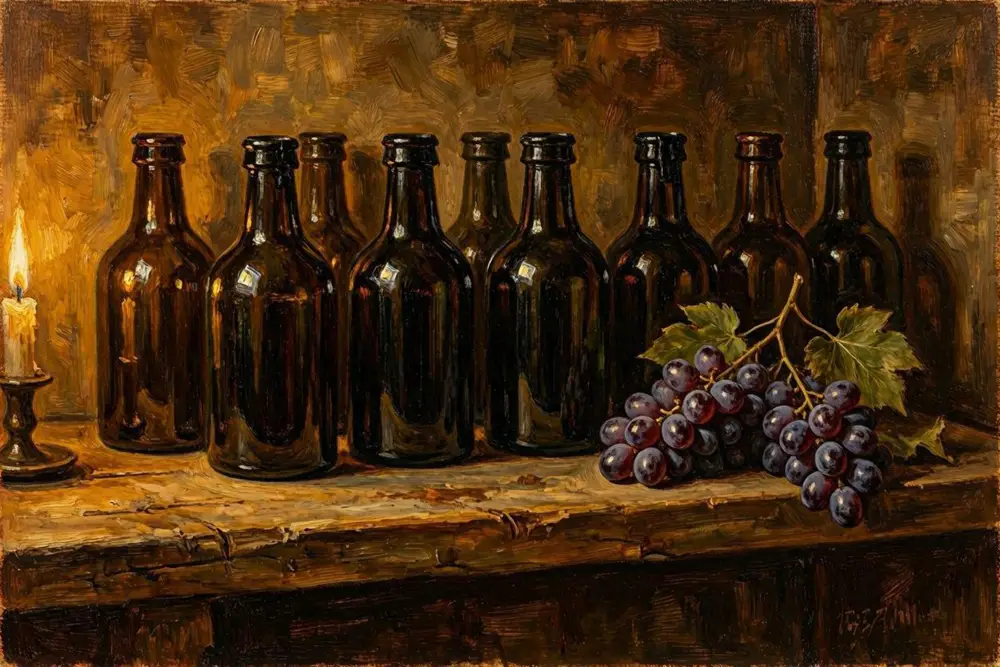
The resin dip is the final and most consequential step. Black resin — a natural pine-based sealant available in the period — is melted and the bottle necks are dipped into it while the resin is still liquid. The resin hardens around the stopper and the bottle neck, creating a physical barrier against air. The process is repeated after half an hour, when the first coat has set, to fill any voids or thin spots the first dip may have left.
The bottles are then stored upside down in a cool, dry cellar. Inversion keeps the liquid pressing against the stopper from the inside, reinforcing the seal mechanically.
Why No Sugar Is Added
The instruction is explicit: no sugar. This is not an omission — it is a design principle.
The sweetness in the finished bottles comes entirely from the natural sugars of the grapes — primarily fructose and glucose. Because the yeast that would convert those sugars to alcohol has been killed by heat and excluded by the seal, the sugars remain in the liquid indefinitely. Adding sugar would change the flavor profile and, in a sense, would misrepresent the product — the whole point is that this is the grape, preserved as itself.
It also means the flavor of the final must is entirely dependent on the quality and ripeness of the fruit. There is no correction available. Grapes that are underripe or damaged at harvest will produce a must that reflects those qualities accurately, for years.
The Relationship to Modern Canning
This technique is not primitive — it is a formally correct application of a principle that industrial food science later systematized into hot-fill canning and pasteurization. The reasoning is identical: kill the spoilage organisms with heat, seal before recontamination can occur, and store in conditions that prevent any further biological activity.
What the early 20th century cook was doing intuitively, modern food science can now describe precisely. The critical control points in this process — the temperature of the must at fill, the internal temperature of the bottle at seal, the integrity of the seal itself — are exactly the parameters that modern home canning protocols specify in measurable terms.
The resin seal was an effective solution for its time. A contemporary home cook working from the same principle would use proper canning jars, a water bath or steam canner, and food safety guidelines calibrated to the acidity of the must being preserved. The logic is continuous; the tools have been refined.
One further note on safety: this technique is appropriate for high-acid liquids. Fresh grape must and most grape juices typically fall well below pH 4.6 — the conventional threshold below which Clostridium botulinum is unable to grow and produce toxin under normal food conditions. The same hot-fill approach, applied to low-acid vegetables, meats, or mixed preparations without pressure canning, would not carry the same margin of safety. Acidity is what makes fruit preservation comparatively forgiving; it is not a universal property of all home-canned foods.
Practical Takeaways
The technique documented here rests on three principles that remain valid in any kitchen:
Heat kills yeast. A full rolling boil is sufficient to eliminate the organisms responsible for fermentation. There is no need for additives if the heat is applied correctly and the transfer to a sealed container is immediate.
Speed matters at the transfer. The value of boiling is lost if the must is allowed to cool in an open pot before bottling. The entire point is to fill sealed containers while the liquid is still at a temperature hostile to microbial activity.
The seal determines the shelf life. A compromised seal — a poor cork, a thin resin coat, a crack in the glass — allows air back in, and air brings yeast. The double-dip resin process and the inverted storage both address this from different angles. Modern vacuum-seal lids address it differently, but the concern is the same.
A recipe like this is also a window into how much early 20th century home cooks understood about preservation — not in the vocabulary of microbiology, but in the practical logic of their methods. The yeast was not named. The mechanism was not explained. But the result, replicated correctly, worked.
Attic Recipes — digitizing and adapting Central European home cooking from the early twentieth century.
Frequently Asked Questions
01Why does grape must ferment so quickly at room temperature?▶
Wild yeast is present on grape skins and in the air. Once the grapes are pressed, yeast begins converting natural sugars to alcohol within hours. Without intervention — heat, sulfites, or cold — fermentation is essentially inevitable.
02How does rapid boiling prevent fermentation in grape must?▶
Heat kills the wild yeast and bacteria responsible for fermentation. If the must is brought to a full boil quickly and sealed immediately while still hot, no live yeast remains to drive the process. The sugar stays intact rather than converting to alcohol.
03Why were the bottles filled warm and stored upside down?▶
Filling warm bottles with hot liquid prevents thermal shock and cracking. Storing the sealed bottles upside down creates pressure against the stopper from the inside, which reinforces the seal and makes it harder for air to enter even if the resin is imperfect.
04Is this the same as vincotto or mosto cotto?▶
Not quite. Vincotto and mosto cotto are produced by long, slow cooking that dramatically reduces the must into a thick syrup. This technique uses a rapid boil — just enough to kill yeast — and does not reduce the volume significantly. The goal is preserved juice, not a concentrate.
05Can this technique be replicated today?▶
The principle is sound and is closely related to modern hot-fill canning. A home cook could achieve a similar result using a water bath canner and proper canning jars with fitted lids. Food safety guidelines recommend confirming acidity levels and processing times for the specific fruit before attempting preservation.