How Macaroni Became a Symbol of Italy
The story of how a simple pasta shape became closely tied to Italian identity and global food culture.
Introduction
The connection between Italy and macaroni seems obvious today — embedded in images, language, and menus worldwide. But this association is not as old as it looks.
Before the 19th century, what we now call Italian cuisine did not exist as a unified concept. The Italian peninsula was a collection of separate states, each with its own food traditions shaped by local agriculture, climate, and history. Pasta was part of this landscape — but not everywhere, and not in the same way.
How macaroni moved from being a working-class staple in one region to a global symbol of an entire country is a story involving economics, poverty, politics, and the way outsiders see food.
Naples: From Leaf-Eaters to Macaroni-Eaters
In the 16th century, Neapolitans were known as mangiafoglia — leaf-eaters — because their diet relied heavily on vegetables, particularly cabbage, alongside small quantities of meat. Pasta existed but was not central to everyday life.
This changed in the 17th century, and not for comfortable reasons.
Under Spanish rule, a combination of political mismanagement and population growth disrupted the food supply. Meat and vegetable prices rose; wheat became relatively cheap. At the same time, Neapolitan craftsmen developed two key pieces of technology: the mechanical kneading machine and the pasta press. Together, these reduced the cost of pasta production significantly.
The result was a shift in diet. Pasta replaced meat and cabbage as the staple of the urban poor. By the late 17th century, Neapolitans had acquired a new nickname: mangiamaccheroni — macaroni-eaters. The term had previously been applied to Sicilians, who had been producing and eating pasta since the 12th century. Now it transferred to Naples, where the scale of consumption was becoming impossible to ignore.
By 1785, Naples had around 280 pasta shops. When Goethe visited in 1787, he noted that macaroni could be bought everywhere for very little money, cooked simply in water and seasoned with grated cheese.
Street Food and the Grand Tour
What made Neapolitan macaroni visible beyond the city was the Grand Tour.
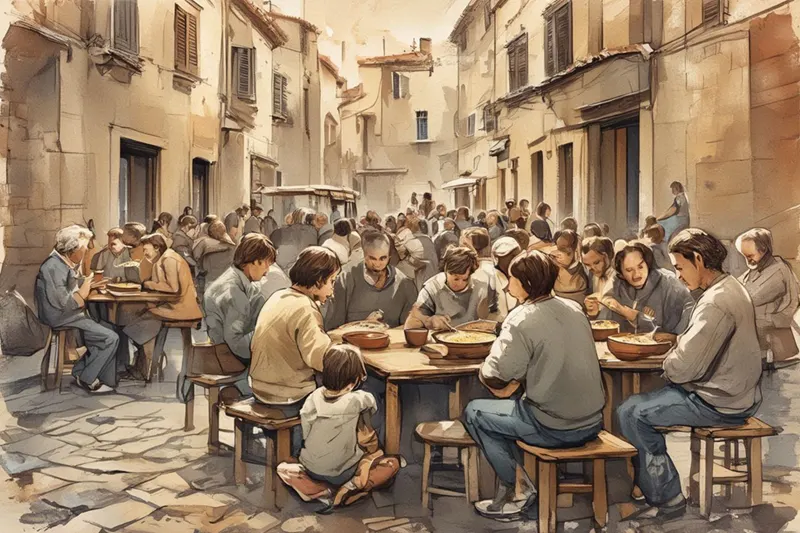
From the 17th century onward, wealthy Northern Europeans traveled through Italy as part of their education. Naples was a major stop, and the spectacle of street vendors selling pasta from open cauldrons — with customers eating long strands by hand, lowering fistfuls into their mouths in a single gulp — became one of the defining images these travelers brought home.
Writers, painters, and printmakers depicted the mangiamaccheroni repeatedly. The images circulated widely. Whatever their accuracy or the social condescension behind them, they fixed a particular picture of Naples in the European imagination: a city where people ate pasta in the streets, with their hands, as a matter of course.
This visibility had consequences. It established pasta — and specifically macaroni — as a defining feature of Neapolitan, and by extension southern Italian, life in the eyes of outsiders.
Unification and the Making of a National Symbol
The transformation from regional food to national symbol happened through politics.
When the Italian states unified in the mid-19th century, the new nation faced the challenge of building a shared identity across regions with very different languages, economies, and food traditions. In the north, polenta and rice dominated. In the south, pasta was the staple.
The Piedmontese, who led the unification process from the north, played a significant role in this shift. Adopting pasta as a symbol of the new united Italy was partly a political gesture — a way of acknowledging and incorporating the south into a shared national identity. Regional foods that had belonged to specific places began to circulate more widely and carry new meaning.
Macaroni, already famous through decades of foreign observation and depiction, was well positioned for this role. It was recognizable, it was cheap, and it had a vivid public history.
Industrialization and Emigration
The late 19th and early 20th century completed the process through industry and migration.
Pasta factories expanded across southern Italy, particularly around Naples and in Gragnano, a town near Naples whose climate — warm days, coastal breezes, and cool nights — was considered ideal for controlled drying. Mechanical production standardized shapes and reduced costs further.
At the same time, large-scale emigration carried pasta traditions to the United States, Argentina, and elsewhere. Italian immigrants adapted their recipes to new ingredients and contexts, but the core remained recognizable. In their new countries, pasta became a marker of Italian identity — and as these communities grew and became visible, that association fed back into broader culture.
By the early 20th century, macaroni had completed a journey from the streets of 17th-century Naples to the global imagination, where it stood as shorthand for Italy as a whole — despite the fact that, for much of Italian history, most Italians had eaten very little of it.
Sources
-
Capatti, A. & Montanari, M. (2003). Italian Cuisine: A Cultural History. Columbia University Press. https://cup.columbia.edu/book/italian-cuisine/9780231122320
-
Serventi, S. & Sabban, F. (2002). Pasta: The Story of a Universal Food. Columbia University Press. https://cup.columbia.edu/book/pasta/9780231124423
-
Davidson, A. (2014). The Oxford Companion to Food (3rd ed.). Oxford University Press. https://worldcat.org/isbn/9780199677337
-
Dickie, J. (2007). Delizia! The Epic History of the Italians and Their Food. Free Press. https://worldcat.org/isbn/9781416554004
-
Wikipedia contributors. Neapolitan cuisine. Wikipedia. https://en.wikipedia.org/wiki/Neapolitan_cuisine
-
Atlas Obscura. Eating Spaghetti by the Fistful Was Once a Neapolitan Street Spectacle. https://www.atlasobscura.com/articles/spaghetti-eaten-by-hand-naples
Attic Recipes — digitizing and adapting Central European home cooking from the early twentieth century.
Frequently Asked Questions
01Was macaroni always associated with Italy?▶
No. Before the 19th century, pasta was a regional food, not a national one. Its strong association with Italy developed gradually, particularly through the visibility of Neapolitan street culture and, after unification in the mid-19th century, through a deliberate adoption of southern food traditions as national symbols.
02Why was Naples so important for macaroni?▶
Naples became a major center of pasta production in the 17th century due to a combination of factors: the climate was ideal for outdoor drying, the mechanical press made large-scale production cheaper, and a sharp rise in meat prices under Spanish rule pushed the urban poor toward pasta as a staple.
03When did pasta become a national symbol of Italy?▶
After Italian unification in the mid-19th century. The northern Piedmontese, seeking common ground with the south, adopted pasta as a symbol of national unity — transforming what had been a regional southern food into a shared Italian identity.
04Did all Italians historically eat pasta regularly?▶
No. Before industrialization, pasta was primarily a staple of the urban poor in Naples and Sicily. In northern Italy, polenta, rice, and bread dominated. Pasta became more widespread across all regions only with industrial production and the political process of unification.